Price Discovery on the Iran Mercantile Exchange: A Step-by-Step Guide
Fundai Education Team · · 8 min read

How the base price is built, the priority on which the auction executes, and how to measure buyer competition, with a hypothetical example and Fundai's Iran Mercantile Exchange filter.
Price discovery on the Iran Mercantile Exchange starts from a base price and arrives at the trade price through buyers competing in an auction. This step-by-step guide shows how the base price is built, what changes when a commodity goes unsold, the priority on which the auction executes, and how to measure competition. At the end you track the same data on Fundai's filters page.
Why is price discovery on the Iran Mercantile Exchange based on an auction?
The price of exchange-traded commodities is discovered in an auction, because the law required commodities admitted to the exchange to leave administered pricing and exchange trading is based on competition. Price discovery means the final price comes from the meeting of buyers and sellers, not from an administrative order. The legal basis for this approach is Article 18 of the Law on the Development of New Financial Instruments and Institutions. According to the text of the law on the Majlis Research Center website, approved on 25 Azar 1388, the government is obliged to take a commodity admitted to the Iran Mercantile Exchange out of the pricing system. So the price of such a commodity is not set by a tariff and must form in the market.
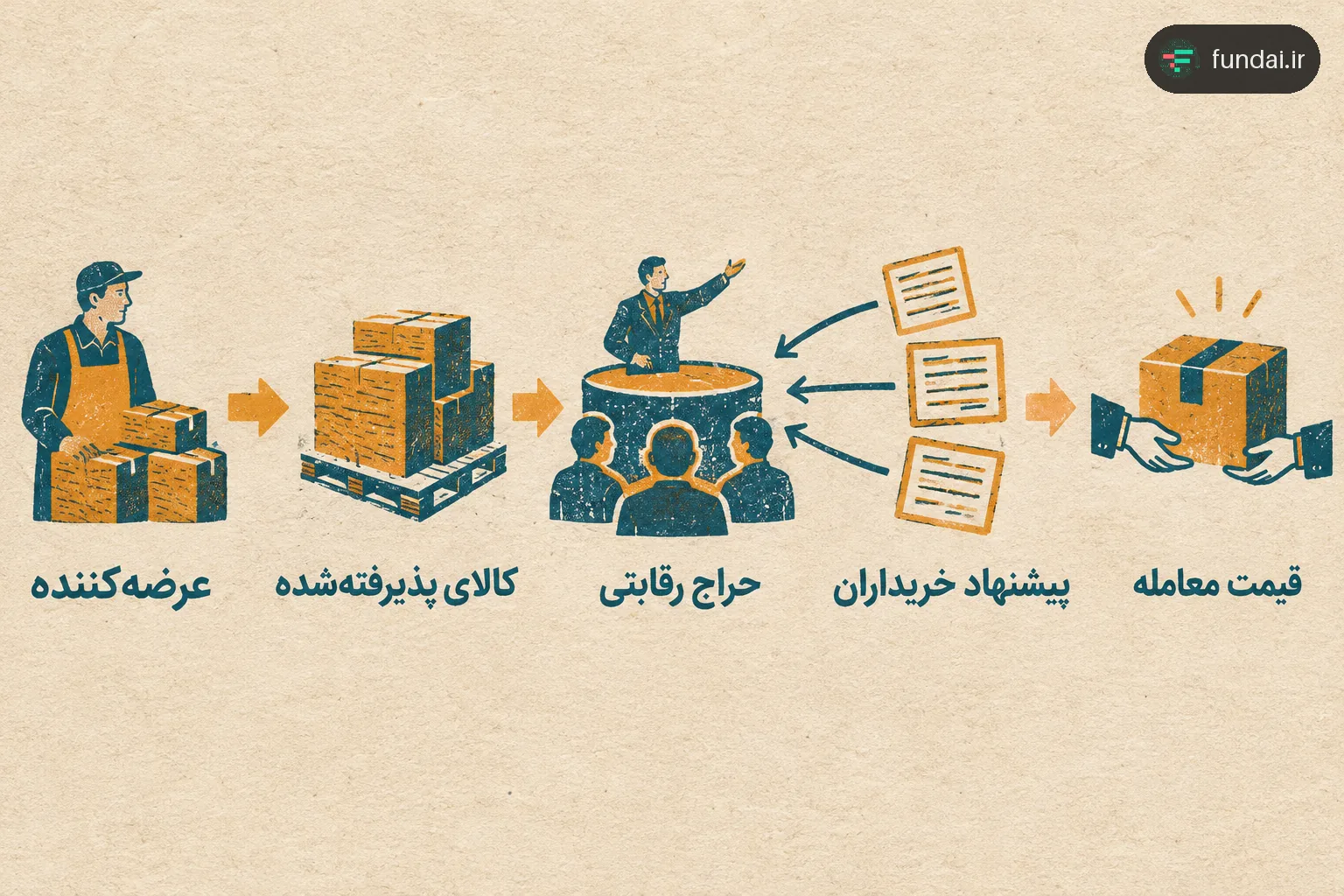
The second principle is that trading is competitive. According to the regulations published on solh.ir, exchange trading is always conducted on a competitive basis and through auction methods.
An auction needs a starting point. That point is the base price: the price from which the offering of the commodity begins and against which buyers' bids are measured.
How is the base price set on the Iran Mercantile Exchange?
The base price on the Iran Mercantile Exchange is the starting point of the auction and is built with a separate formula for each commodity group. The example that has a source is petrochemical products.
According to the Mehr News Agency report on the market regulation instruction, published on 1396/09/29, the base price is the Persian Gulf FOB price multiplied by the exchange rate on the Sana system and then multiplied by 95%.
Take the Persian Gulf FOB price The product's price in dollars is the first input of the calculation.
Multiply it by the Sana system exchange rate The dollar price is converted to rials.
Multiply the result by 0.95 The resulting figure is the offering base price.
FOB price in rials per tonne (rials)
Hypothetical base price per tonne (rials)
In this hypothetical example the base price comes to 19,000,000 rials per tonne; that is, 95% of the FOB price converted to rials.
Once the base price is set, buyers' bids are not unrestricted. According to a Rahavard 365 report, the permitted price band for bids in auctions of commodities such as petrochemical products is, in the initial range, plus and minus 10% of the base price.
Floor of the range (rials)
Ceiling of the range (rials)
If the commodity goes unsold, what happens to the next session's base price?
Under the Iran Mercantile Exchange trading instruction, if the commodity is not traded in the offering session, the next session's base price falls 5%, and if the trade is below 50% of the offered volume, the fall is 3%.
We cite this rule from the version of the instruction published on the Persian Gulf Cement website. Its scope is that instruction itself and it does not extend to all commodities.
5% cut in the base price (rials)
Next session's base price (rials)
3% cut in the base price (rials)
Next session's base price (rials)
In this hypothetical example, the next session's base price is 9,500,000 rials in the no-trade case and 9,700,000 rials per tonne in the case of a trade below half the volume.
In the monthly report, a product's selling rate is that product's sales amount divided by that product's sales quantity in the same month. To gauge how it changes, put the offering base of the same period beside it.
How does an Iran Mercantile Exchange auction run, and how is competition calculated?
In an Iran Mercantile Exchange auction, orders are executed first by price and then by time of entry, and the distance of the trade price from the base price shows buyers' competition.
Under the same regulations, orders are executed by price priority, and if two orders have the same price, time priority of entry into the system decides.
According to an piece from the Heyva legal website, with the addition of the simultaneous auction to the physical market of the Iran Mercantile Exchange, there are three auction models: the ordinary auction, the open auction and the simultaneous auction.
The base price is announced The offering starts from the base price, and this price is the benchmark for measuring bids.
Buyers place bids Each buyer enters the price and quantity they want into the system.
Orders are given priority The order with the better price comes first, and at an equal price the order entered earlier is placed ahead.
The trade price is measured against the base price You calculate the distance of the trade price from the base price as a percentage; this figure is the competition percentage.
The competition percentage is how many percent above or below the base price the trade price closed. This figure describes only a past trade.
General formula
Difference between trade price and base price (rials)
Ratio of the difference to the base price
Competition percentage (percent)
How do you filter Iran Mercantile Exchange trades on Fundai?
To filter Iran Mercantile Exchange trades on Fundai, you open the Filters page and build a condition from the Iran Mercantile Exchange family. Each step below is a decision on that same page.
Define the scope with a general filter In "General filters", choose an industry, sub-industry, company symbol or your own watchlist.
Set the condition family to "Iran Mercantile Exchange" Choose the period as monthly or daily. In the daily period, the comparison is made against the offering base.
Choose the parameter and the type of comparison The parameter can be sales quantity or amount, sales value or realised revenue, and selling rate. The comparison type is "simple" or "relative".
Set the level of analysis and the market Choose between "all products" and "a specific product", and pick the market as domestic or export.
Enter the operator and the number Write one of the operators "greater than", "less than", "greater than or equal to" or "less than or equal to" with a number. Conditions in one group hold together, and groups are combined with "or".
The free plan gives the filter on companies' Iran Mercantile Exchange trading information in "simple comparison" mode. According to the pricing, the "Fundamental-related filters" plan adds the "cumulative" and "monthly breakdown" modes and costs 550,000 tomans a month; the "Multiple filters" plan also includes applying several filters at once and costs 650,000 tomans a month. The steps for working with the filters page are also covered in the user guide.
Summary: from the base price to tracking on Fundai
The parts of this article form a chain: the law left pricing to the market, the base price opens the auction, and order priority decides who reaches the commodity first. If no trade happens or the trade is small, the next base price comes down. The distance of the trade price from the base also shows how much buyers competed for the commodity.
Fundai's filter brings this same chain to real data. The distance from the offering base describes only past trades, and a past figure does not guarantee the future. To go further, build an Iran Mercantile Exchange condition and take the resulting companies. Then open the same company's monthly report on the Codal system and check the sales amount and sales quantity of the same product against the filter's selling rate.
How does price discovery on the Iran Mercantile Exchange differ from administered pricing?
In price discovery, the final price comes out of the meeting of buyers' and sellers' bids in an auction. In administered pricing, an administrative body sets the rate in advance.
If two orders arrive at the same price, which is executed first?
The order that entered the system earlier comes first; execution is first by price priority and, in a tie, by time priority.
What does a negative competition percentage mean?
It means the trade price closed below the base price. Its formula is the difference between the trade price and the base price divided by the base price.
#Education #Iran Mercantile Exchange #Auction #Stock Screener #Base Price #Price Discovery