How Cement Base Prices Are Calculated on the Commodity Exchange
Fundai Education Team · · 7 min read
Review the adjustment rules and real trading data for SARUM and SOKHAZAR to examine the cement base price step by step.
How the base price of cement is calculated on the Commodity Exchange is tied to the previous week's competition percentage, according to a directive that Donya-e-Eqtesad reported in Esfand 1404. However, the base price of type 2 bulk cement for Urmia Cement and Khazar Cement rose by 0 to 1.5 percent in each of the last four offerings; less than the figure the formula gives with the rate recorded at each offering. The official text of the notice and the supply commitment coefficient are not in our data, so the calculation in this article is for educational purposes.
Step 1: What is the base price on the commodity exchange?
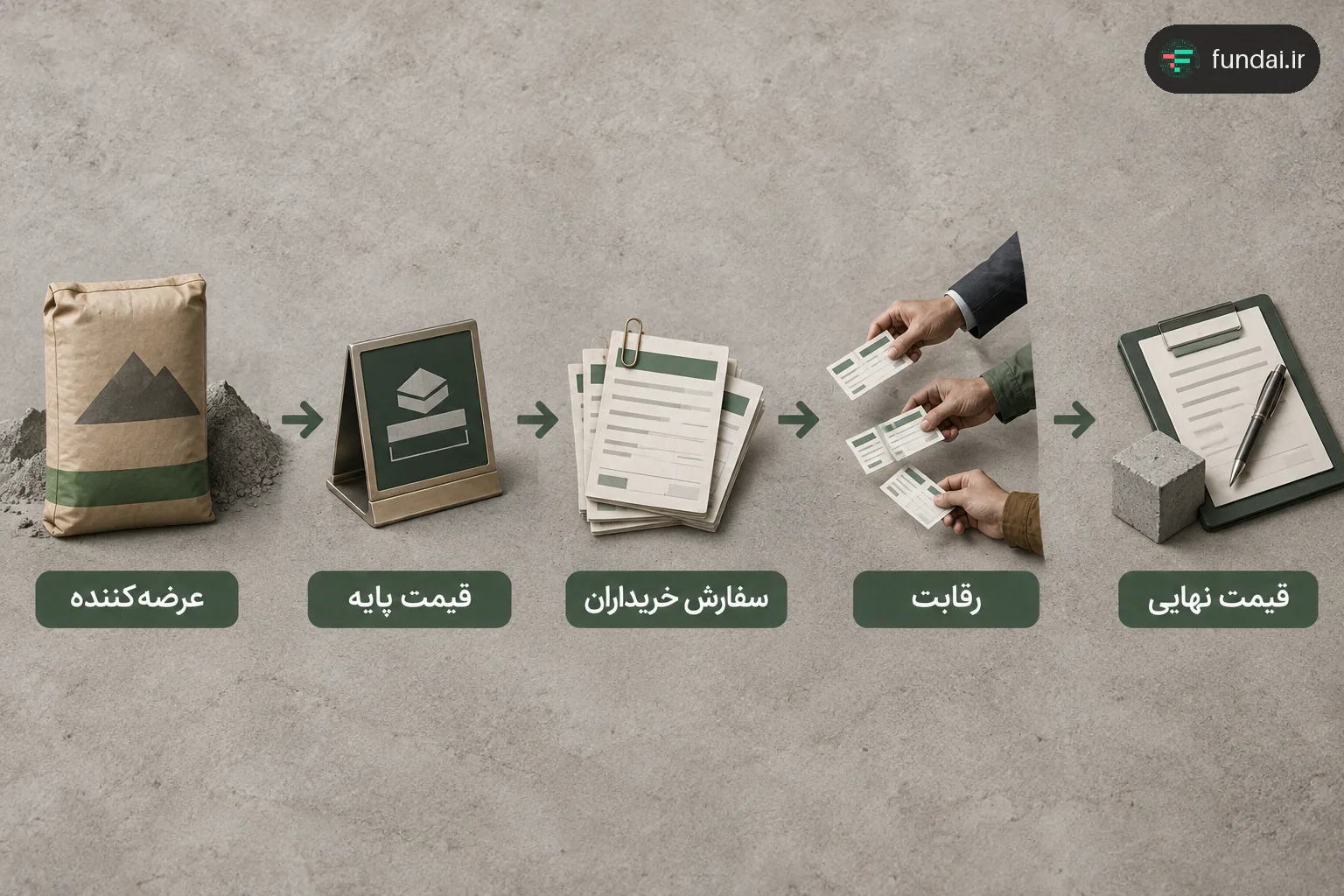
The base price on the commodity exchange is the lowest rate the seller states in the offering notice, and the auction starts from that figure. Buyers place orders at that rate or higher, and the rate at which the trade closes is the discovered price. If no buyer bids above the base, any trade that takes place is at the base rate itself. On the SARUM commodity exchange page you can see both rates for every offering.
How is cement offered on the commodity exchange?
Cement offerings on the commodity exchange are weekly in our data for SARUM and SKHAZAR, and each type and packaging (bulk or bagged) is offered separately; so each product has its own base rate.
Step 2: How does the discovered cement price differ from the base price?
The gap between the discovered cement price on the Commodity Exchange and the base rate shows how intense the buyers' competition is; demand exceeding supply alone does not push the price up. Find the 12/07/1405 row for Type 2 bulk cement on the SEKHAZAR Commodity Exchange page and calculate the competition percentage as follows:
Competition percentage
SEKHAZAR (thousand rials per tonne)
| Symbol | Identical product | Base price | Discovered price | Supply (tonnes) | Demand (tonnes) | Competition percentage |
|---|---|---|---|---|---|---|
| SARUM | Portland Type 2 cement, grade 42.5 - bulk | 32,485 | 37,920 | 8,500 | 14,400 | 16.73% |
| SEKHAZAR | Portland Type 2 cement, grade 42.5 - bulk | 30,012 | 39,321 | 12,000 | 19,760 | 31.02% |
| SARUM | Portland Type 2 cement, grade 42.5 - 50 kg bag | 44,577 | 47,236 | 1,500 | 3,375 | 5.96% |
| SEKHAZAR | Portland Type 2 cement, grade 42.5 - 50 kg bag | 39,913 | 49,476 | 10,000 | 18,290 | 23.96% |
To compare the cement price on the Commodity Exchange, place only identical products from the same day side by side: SEKHAZAR offered at a lower base and reached a higher price.
Step 3: How is the base price of cement calculated on the Commodity Exchange?
How is the base price of cement determined on the Commodity Exchange? According to the rules that Boursepress published on 25 Ordibehesht 1404, if a symbol was not offered in the previous week, the base rate is the lowest base rate of that symbol over the past 4 weeks minus 2 percent; and the maximum base rate is the weighted average price discovered 4 weeks earlier plus 3 percent.
The instruction that Donya-e-Eqtesad reported on 2 Esfand 1404 describes a tiered rule; we do not have its official text and do not know whether this same version was applied to the trades of Mehr 1405. If a symbol had no trades in the previous week, the base rate does not change. If up to 20 percent of the offered volume is traded at the same base rate, the base rate falls by up to 3 percent, by 2 percent if between 20 and 80 percent is traded, and by 1 percent if more than 80 percent is traded. With competition, the new base rate is built from the discovered weighted average and the previous base rate, its increase is capped at 20 percent, and an offering below the weekly commitment receives an adjustment coefficient:
Competition up to 10 percent
Competition of 10 to 25 percent
Competition above 25 percent
Growth cap
Step 4: What number does this formula give for the Sarom and Sakhazar trades?
We took the base and discovered-price columns of the last two offerings of bulk Portland Type 2 cement from each symbol's Iran Commodity Exchange page, put them into the formula, and set the results next to the base rate the company announced the following week. Our data has one discovered price per offering, and we have assumed it equals that week's weighted average; if there was another trade during the week, the result would differ. Figures are in thousand rials per ton.
| Symbol and date | Base | Discovered | Competition | Base per formula with one trade per week | Base announced the following week | Actual change |
|---|---|---|---|---|---|---|
| SAROM 1405/06/29 | 31,676 | 35,403 | 11.77% | 33,540 | 32,050 | 1.18% |
| SAROM 1405/07/05 | 32,050 | 36,504 | 13.90% | 34,277 | 32,485 | 1.36% |
| SAKHAZAR 1405/06/29 | 29,577 | 31,168 | 5.38% | 31,168 | 29,577 | 0% |
| SAKHAZAR 1405/07/05 | 29,577 | 34,414 | 16.35% | 31,996 | 30,012 | 1.47% |
Competition (percent)
Base per formula (thousand rials per ton)
Change in announced base rate (percent)
In all four cases, the announced base rate rose by less than this figure; for Sakhazar, after 5.38 percent competition, the base rate did not change. Our data cannot tell us where this gap comes from: another trade in the same week, a supply commitment adjustment coefficient, or a rule not mentioned in these two reports may have had an effect. For the following week's rate, refer to that week's offering notice on the Iran Commodity Exchange.
Step 5: How is commodity exchange competition reflected in the monthly report and in company profit?
In the monthly report, find the row for the same product and divide the sales amount by the quantity sold. According to the Urmia Cement monthly report, sales of Type 2 bulk cement in Shahrivar 1405 were 122.4 billion tomans for 35,434 tons, and according to the Khazar Cement monthly report, sales of Type 2 bulk cement were 145.1 billion tomans for 47,314 tons.
SARUM: 122.4 billion tomans equals 1,224,000,000 thousand rials (thousand rials per ton)
SEKHAZAR: 145.1 billion tomans equals 1,451,000,000 thousand rials (thousand rials per ton)
These rates are slightly below the discovered rates for Shahrivar, for example 35,403 for SARUM and 31,168 for SEKHAZAR on 1405/06/29. The monthly report presents the sales recognised in that month, not the trades on the exchange floor, so read the two rates separately.
The same calculation in the Urmia Cement monthly report shows the selling price of Type 2 bulk cement at 32,433 in Tir, 33,075 in Mordad and 34,543 thousand rials per ton in Shahrivar 1405. This increase raises the gross profit margin only if the cost of goods per ton grows more slowly; total profit also depends on the quantity sold and on other expenses. To check, in the SARUM income statement, compare operating revenue, cost of goods sold and gross profit for one quarter with the previous quarter: if revenue has grown faster, the margin has improved; but this comparison does not prove the effect of commodity exchange competition, because product mix and costs also have an effect, and the quarterly income statement is not broken down by product. The gross profit margin is that quarter's gross profit divided by that quarter's operating revenue, multiplied by 100; see its trend on the SARUM profit margin page.
| Quarter ended | Gross profit margin (percent) | Net profit margin (percent) |
|---|---|---|
| Shahrivar 1403 | 64.3 | 57.0 |
| Azar 1403 | 63.0 | 44.3 |
| Esfand 1403 | 40.7 | 105.7 |
| Khordad 1404 | 68.4 | 58.2 |
| Shahrivar 1404 | 63.8 | 58.8 |
| Azar 1404 | 67.5 | 67.6 |
| Esfand 1404 | 59.9 | 126.9 |
| Khordad 1405 | 69.9 | 65.0 |
How do we track cement trades on the commodity exchange in Fundai?
In Fundai, cement trades on the commodity exchange sit alongside each company's monthly report. On the filters page, select the "Cement, Lime and Plaster" industry from "General filters" and create a condition from the commodity exchange family with the parameter "selling rate", period "daily", comparison "relative" with the origin "offer base" and the operator "greater than" zero, to list the symbols that have sold above the base rate.
What is the base price on the commodity exchange?
It is the lowest rate the seller announces in the offer notice, and the auction starts from it.
How does the discovered cement price differ from the base price?
The base price is the starting rate of the auction, and the discovered price is the rate at which the trade is closed after buyers compete.
How is cement offered on the commodity exchange?
In our data, SARUM and SEKHAZAR offer each type and packaging weekly and separately at its own base rate, and buyers place orders on the trading floor.
How is the base price of cement on the commodity exchange determined?
According to a Donya-e-Eqtesad report on the Esfand 1404 directive, it depends on the previous week's competition percentage and can rise by at most 20 percent.
#Iran Mercantile Exchange #Fundamental Analysis #Cement Industry #Base Price