What Is FX Revaluation Gain? Step-by-Step Guide on Fundai
Fundai Education Team · · 8 min read

Use a hypothetical example to calculate how exchange rate changes affect foreign-currency receivables and payables, and learn where the gain is recorded and how it limits dividend distribution.
The answer to the question "What is foreign exchange translation gain?" is this: a gain arising from a change in the rial value of foreign-currency items due to differences in exchange rates, which is not necessarily accompanied by the receipt of cash. To assess its effect on a company's report, you need to identify the type of foreign-currency item, the base rate, and where the translation difference is recorded.
Step 1: What Is Foreign Exchange Translation Gain, and Which Items Should You Check?
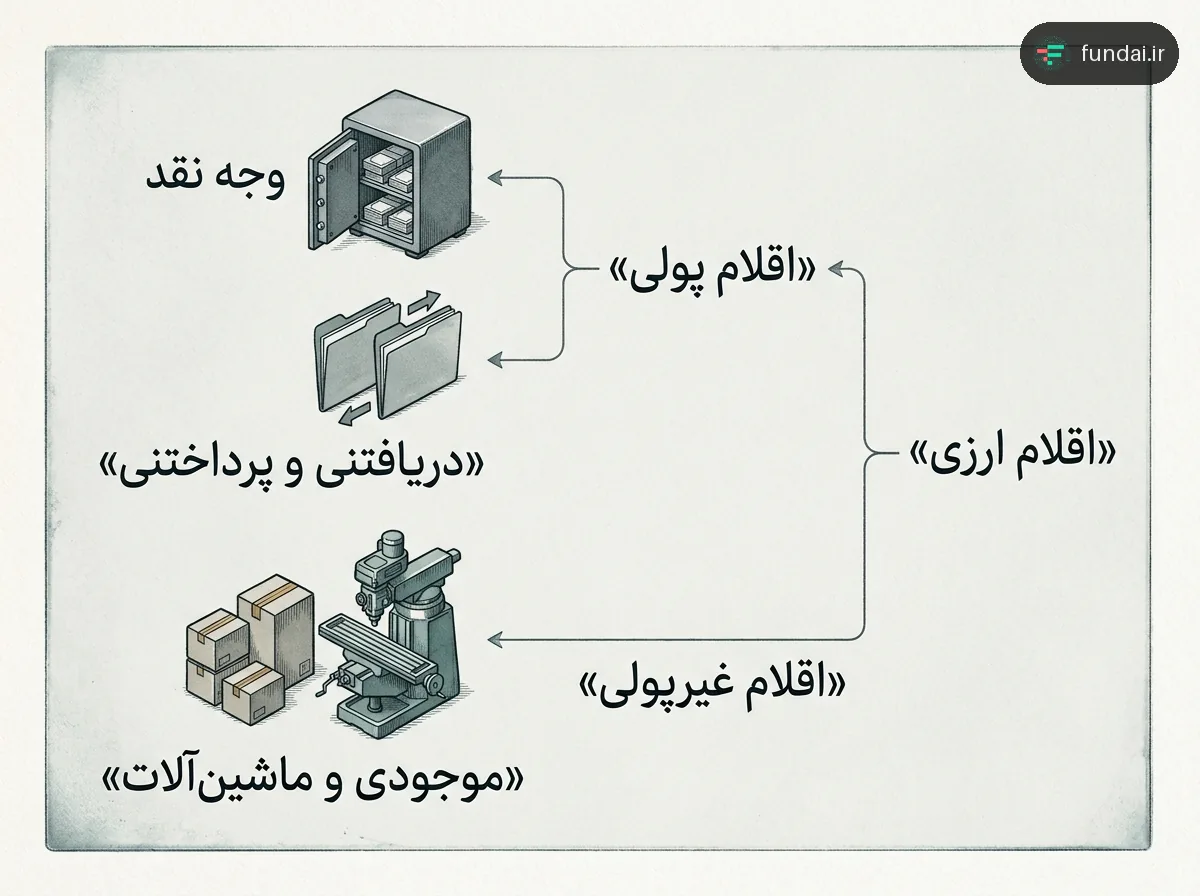
Foreign currency translation is the expression of foreign-currency financial information in the reporting currency; begin your review by separating monetary items from non-monetary items. According to Accounting Standard No. 16, The Effects of Changes in Foreign Exchange Rates, translation is a process in financial reporting, not the name of an export income. Monetary items include cash and assets or liabilities that will be received or paid in a fixed or determinable number of currency units. For a practical answer to the question "what is foreign exchange translation gain," review the company's foreign-currency cash balances, foreign-currency receivables and foreign-currency payables; merely having export activity does not determine the composition of foreign-currency items.
Non-monetary items such as inventory and fixed assets are not a right to receive or an obligation to pay a fixed or determinable number of currency units. Under Accounting Standard No. 16, non-monetary items carried at historical cost are translated at the rate on the transaction date; for items measured at fair value, the rate on the measurement date is the basis. Therefore, do not extend the translation rule for monetary items to all assets purchased with foreign currency.
On the company page in Fundai, open the statement of financial position and find the receivables and payables line items. We organize published financial statements; to identify the foreign-currency portion of each line item, read the notes to the same statement on the Codal system. If you are not familiar with the path to the reports, use the Fundai user guide.
Step Two: How Is Foreign Exchange Translation Gain Calculated, and Which Rate Is the Base Rate?
The difference between the period-end rate and the book rate changes the rial value of foreign-currency monetary items; a rate increase creates a gain on receivables and a loss on payables. Take the base rate from the translation bases stated in the same report, not from the market rate or from a rate announced for another industry. The foreign-currency balance and the book rate of each item must be known for the calculation.
Rate increase per dollar (rials)
Translation gain on receivables (rials)
Translation loss on payables (rials)
Net effect before tax (rials)
According to a Mehr News Agency report, published on 02/01/1404, the dollar rate for translating the foreign-currency monetary assets and liabilities of banks and non-bank credit institutions at the end of Esfand 1403 was announced as 681,203 rials. The basis was the ETS remittance purchase rate on 28/12/1403. The scope of the announced rate is the banking report of that period; do not substitute it for the rates of other companies.
Separate the presentation unit of the financial statements from the reporting period. The presentation unit, such as rial or dollar, is the basis for expressing amounts; quarterly, cumulative and annual are reporting periods. A change in presentation unit alone does not indicate the recognition of a translation gain. To identify the accounting effect, check the amount of the translation difference and the basis for recording it in the notes to the same report.
Step 3: Where is foreign exchange translation gain recorded in the financial statements?
Find where the translation difference is recorded from the income statement and the note for the relevant line item; the line item's title alone is not enough to identify it. Other income and non-operating expenses is one possible location, not a definitive one for all companies. The classification depends on the nature of the item and the reporting practice; do not read the total amount of the line item as the translation gain.
Open the income statement On the company page in Fundai, open the income statement report and identify the period and whether the statement is separate or consolidated. We organize the published figures for reading and comparison. To understand how the line items relate to each other, see the guide how to read an income statement.
Read the components of the line item in the note Follow the note number of the possible line item in the main report. Extract the amount of the translation difference, the related items and the basis of recognition from that note. If the necessary breakdown is not clear in the report summary, the total figure is not enough to determine the translation share.
Determine the scope of the effect Check whether the amount appears in the profit and loss of the period or is recorded in equity. To measure the translation share of profit, the translation amount and the profit used as the basis of comparison must belong to the same period and the same financial statement.
Then read the statement of cash flows and the explanations of the related adjustments alongside the income statement. The goal is to identify the difference between recognized profit and cash flow; positive cash flow alone does not prove that the translation gain was cash-based. To explain the link between profit and cash, examine the source of funds and the adjustments related to profit items.
Step 4: Can banks' foreign exchange revaluation gains be distributed?
If retained earnings are positive, banks' revaluation gains on monetary items cannot be distributed in cash and must be used for a capital increase. According to the banking regulations document on Davoudabadi, revaluation gains on monetary items, meaning foreign-currency assets and liabilities at fiscal year-end, are transferred to the period's profit and loss; if the retained earnings balance before the allocation of reserves is positive, this amount is not distributable profit and must be used for a capital increase.
According to the same Davoudabadi document, if the retained earnings balance shows a loss, the revaluation gain will only reduce the accumulated loss. Therefore, recording a revaluation gain in a bank's profit and loss does not mean the same amount can be paid out to shareholders.
To review your chosen bank, first identify where the revaluation difference is recorded; then read the retained earnings position before the allocation of reserves. Keep the ruling on profit allocation separate from the ruling on the accounting place of recording.
According to a Mehr News Agency report published on 1404/01/02, the revaluation difference on state-owned banks' foreign-currency assets and liabilities is not treated as income or expense for the period and is recorded in the revaluation difference account under equity. This ruling applies to state-owned banks; do not extend it to non-bank companies.
On Fundai, view a company's cash dividend history; we display the published record. To review dividend distribution for your chosen period, put the general meeting resolution, the related notes and that company's regulatory documents side by side. A payment history is not a substitute for checking whether profit for the period in question is distributable.
Step 5: Summary — How to Review the Translation Effect in Fundai
To review the translation effect, read the company's financial statements and use filters to select companies that need review. The article's hypothetical example only identified the pre-tax effect; determining the effect on net profit and distributable profit requires more information.
Open the company's financial statements On the company's page in Fundai, read the statement of financial position and the income statement for the same period and statement type. Match the translation amount, the base rate and where it was recorded against the notes of the same report on Codal; identifying foreign-currency balances requires these notes.
Define the filter condition On the filters page, select the scope of review from "General filters". Then build a condition from the "Income statement" or "Operating revenue" family and, for the variable you are examining, set an operator such as "Greater than" and your own benchmark number. We display the companies that match the condition; the filter result alone does not isolate the translation effect.
Match the results against the report Open the financial statements of the companies in the filter result and review the translation effect against the related note. To read the net profit margin, keep the time basis of net profit and operating revenue the same; do not mix a period figure with TTM. A change in the ratio alone does not determine the share of translation. Past data is not a guarantee of the future.
What is foreign exchange translation gain, and how does it differ from export revenue?
Translation gain arises from the exchange rate difference when converting the value of foreign-currency items into rials. Export revenue relates to the core activity; the translation of foreign-currency receivables arising from exports is separate from recording that activity's revenue.
Does a rise in the exchange rate always create a translation gain?
No. In the article's hypothetical example, the rate increase created a gain for the foreign-currency receivable and a loss for the foreign-currency payable. The net result depends on the mix of foreign-currency balances and the recording basis.
Does foreign exchange translation gain mean receiving cash?
No. Recording the translation difference on an unsettled foreign-currency balance does not by itself create new cash receipts. To review the link between profit and cash, read the cash flow statement and the explanations of adjustments.
#Currency Translation #Financial Statements #Earnings Quality